AdeptTect Flash HS PCR Master Mix (dye plus) is a 2-fold pre-mixed product for rapid PCR reaction with ultra-fast elongation speed (up to 5 sec/kb); at the same time, this product also has high amplification efficiency, high sensitivity, high specificity, high annealing efficiency and other characteristics. The product contains the necessary coloring reagents for electrophoresis (blue and yellow pigments), and the solution of the product appears bright green; when using the product, you only need to add templates, primers and water to the solution to carry out the PCR reaction; you can carry out electrophoresis directly after the PCR reaction, which is easy to operate, minimizes the human error, and obtains the results of the assay in a relatively short period of time. In addition, monoclonal antibody that can inhibit the activity of DNA Polymerase at room temperature is added to this product, which can perform Hot Start PCR and effectively inhibit the formation of primer dimer and non-specific amplification.
The product amplified by this product does not contain the A base at the 3’ end, so it cannot be used for TA cloning.
Product Advantages
① This product is characterized by high amplification efficiency, high sensitivity, high specificity, high annealing efficiency and fast extension speed, which can improve PCR amplification efficiency.
② This product has an extremely fast elongation speed (up to 5 sec/kb).
③ The product is a 2X premix, adding template, primer and water to carry out the PCR reaction, easy to operate, and can minimize human error.
This product contains the necessary color reagents (blue and yellow pigments) for electrophoresis, and can be used for electrophoresis directly after the PCR reaction, so that test results can be obtained in a short time.
Product Composition
individual parts making up a compound
norm
2X Flash HS PCR Master Mix (dye plus)
500 μl x 6 pc
Preservation and transportation
Storage temperature: -20℃
Transportation temperature: dry ice or -20℃ ice bag
Example 1
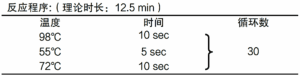
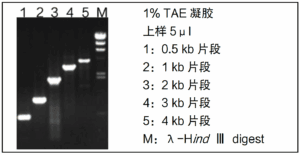
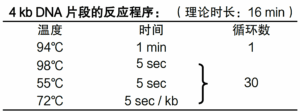
Using Human gDNA as template, this kit can amplify DNA fragments of different lengths at different extension rates, and can amplify 4 kb DNA fragments with an extension time of 10 sec.
The electrophoresis results are shown below:
Example 2
The cDNA obtained by reverse transcription of Human Total RNA was used as a template to amplify DNA fragments of different lengths.
The electrophoresis results are shown below:
Example 3
pick E. coli A single colony was added to 20 μl of RNase free water, mixed well, and then 1 μl of the bacterial solution was used as a template to amplify DNA fragments of different lengths, and 7 kb of DNA fragments were amplified at 3 sec/kb.
The electrophoresis results are shown below:
Example 4
Using Human gDNA as template and different template amounts (500 ng, 300 ng, 100 ng, 10 ng, 1 ng, 100 pg), this kit amplifies 4 kb DNA fragments, and the target fragments can be amplified at an extension rate of 5 sec/kb with template amounts as low as 1 ng.
The electrophoresis results are shown below:
Example 5
Using λDNA as template and different template amounts (5 ng, 1 ng, 100 pg, 10 pg, 1 pg, 100 fg), this kit amplifies 4 kb DNA fragments, and the target fragment can be amplified at an extension rate of 5 sec/kb when the template amount is as low as 100 fg.
The electrophoresis results are shown below:
Example 6
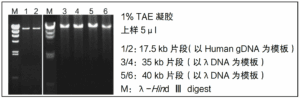
Using Human gDNA (lanes 1~2) as a template, 17.5 kb of DNA fragments can be amplified; using λDNA (lanes 3~6) as a template, 40 kb of DNA fragments can be amplified well.
The electrophoresis results are shown below:
table of examples of experiments
Template Type
Amplification speed
Fragment size (kb)
Sequence GC content
Template Extraction Method
template volume
Can it be amplified
Human gDNA
30 sec /kb
0.5 kb
75.4%
reagent method
100 ng
√
Human gDNA
5 sec /kb
1 kb
36.1%
reagent method
100 ng
√
Human gDNA
5 sec /kb
2 kb
38.1%
reagent method
100 ng
√
Human gDNA
1 min/kb
2.1 kb
26.9%
reagent method
100 ng
√
Human gDNA
4 sec /kb
3 kb
38.7%
reagent method
100 ng
√
Human gDNA
2.5 sec /kb
4 kb
36.0%
reagent method
100 ng
√
Human gDNA
10 sec /kb
6 kb
40.0%
reagent method
100 ng
√
Human gDNA
15 sec /kb
7.5 kb
37.1%
reagent method
100 ng
√
Human gDNA
15 sec /kb
10 kb
37.7%
reagent method
100 ng
√
Human gDNA
15 sec /kb
12 kb
40.0%
reagent method
100 ng
√
Human gDNA
15 sec /kb
17.5 kb
37.4%
reagent method
100 ng
√
Mouse gDNA
5 sec /kb
1 kb
52.2%
Magnetic bead method
100 ng
√
Mouse gDNA
5 sec /kb
2.6 kb
65.2%
Magnetic bead method
100 ng
√
Mouse gDNA
5 sec /kb
3.4 kb
53.4%
Magnetic bead method
100 ng
√
Mouse gDNA
5 sec /kb
4 kb
49.8%
Magnetic bead method
100 ng
√
Mouse gDNA
15 sec /kb
5 kb
49.8%
Magnetic bead method
100 ng
√
Mouse gDNA
15 sec /kb
11 kb
51.6%
Magnetic bead method
100 ng
√
Chicken gDNA
5 sec /kb
0.5 kb
41.0%
Magnetic bead method
74 ng
√
Chicken gDNA
5 sec /kb
1.2 kb
36.6%
Magnetic bead method
74 ng
√
Chicken gDNA
5 sec /kb
1.7 kb
68.6%
Magnetic bead method
74 ng
√
Chicken gDNA
5 sec /kb
2.4 kb
49.4%
Magnetic bead method
74 ng
√
Pig gDNA
5 sec /kb
0.6 kb
47.6%
Magnetic bead method
30 ng
√
Pig gDNA
5 sec /kb
0.8 kb
50.2%
Magnetic bead method
30 ng
√
Pig gDNA
5 sec /kb
2 kb
57.9%
Magnetic bead method
30 ng
√
Pig gDNA
5 sec /kb
2.9 kb
37.7%
Magnetic bead method
30 ng
√
Pig gDNA
10 sec /kb
6 kb
59.3%
Magnetic bead method
30 ng
√
Potato gDNA
5 sec /kb
1.3 kb
39.5%
columnar method
50 ng
√
Potato gDNA
5 sec /kb
2 kb
39.6%
columnar method
50 ng
√
Potato gDNA
5 sec /kb
2.9 kb
38.2%
columnar method
50 ng
√
Potato gDNA
10 sec /kb
5.8 kb
35.4%
columnar method
50 ng
√
Potato gDNA
10 sec /kb
10 kb
38.0%
columnar method
50 ng
√
Tomato gDNA
5 sec /kb
0.5 kb
28.2%
Magnetic bead/column method
120 ng
√
Tomato gDNA
5 sec /kb
1.6 kb
32.2%
Magnetic bead/column method
120 ng
√
Tomato gDNA
5 sec /kb
1.9 kb
36.0%
Magnetic bead/column method
120 ng
√
Tomato gDNA
5 sec /kb
3 kb
37.4%
Magnetic bead/column method
120 ng
√
Tomato gDNA
5 sec /kb
4.4 kb
37.6%
Magnetic bead/column method
120 ng
√
Tomato gDNA
5 sec /kb
5 kb
38.2%
Magnetic bead/column method
120 ng
√
Rice gDNA
5 sec /kb
1 kb
45.6%
Magnetic bead/column method
100 ng/200 ng
√
Rice gDNA
5 sec /kb
3 kb
41.5%
Magnetic bead/column method
100 ng/200 ng
√
Rice gDNA
5 sec /kb
5 kb
40.5%
Magnetic bead/column method
100 ng/200 ng
√
Rice gDNA
10 sec /kb
7.5 kb
46.8%
Magnetic bead/column method
100 ng/200 ng
√
Rice gDNA
10 sec /kb
12 kb
44.6%
Magnetic bead/column method
100 ng/200 ng
√
λDNA
20 sec /kb
30 kb
51.1%
–
2 ng
√
Escherichia coli colony
5 sec /kb
1 kb
53.8%
/
single colony
√
Escherichia coli colony
5 sec /kb
2 kb
51.1%
/
single colony
√
Escherichia coli colony
5 sec /kb
3.5 kb
52.2%
/
single colony
√
Escherichia coli colony
5 sec /kb
5 kb
53.2%
/
single colony
√
Escherichia coli colony
10 sec /kb
6.7 kb
51.8%
/
single colony
√
Escherichia coli colony
10 sec /kb
11 kb
50.7%
/
single colony
√
Note: √ indicates able to amplify, / indicates not extracted. -indicates direct purchase.