Klenow clips (3’-5’ exo-)

Product No.:AG12528

- +

¥200

Product Description

Klenow Fragment (3’→5′ exo-) is a large fragment of E. coli DNA polymerase that has been mutated (D355A, E357A) to lose nucleic acid exonuclease activity. This product has 5′ → 3′ DNA polymerase activity, but lacks 5′ → 3′ nucleic acid exonuclease activity and 3′ → 5′ nucleic acid exonuclease activity, and has some strand replacement activity. It is not recommended for DNA end smoothing reaction because one or more additional nucleotides are often added to the 3′ end in a non-template oriented manner during end smoothing.

Product Composition
individual parts making up a compound norm
Klenow Fragment (3’→5′ exo-) (5 U/μl) 40 μl
10X Klenow Fragment (3’→5′ exo-) Reaction Buffer 250 μl


Preservation and transportation
Storage temperature: -20℃ storage
Transportation temperature: dry ice transportation or -20℃ ice bag transportation
test case
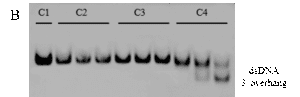
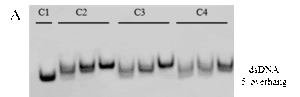
The performance of this product was assayed with a substrate of 33 bp of single-ended protruding double-stranded DNA. where C1: dsDNA with 5’/ 3′ overhang; C2: AG12528 (this product); C3: competitor (competitor company Klenow Fragment exo-); C4: AG12510 (AG Klenow Fragment).
Electrophoresis was performed using a 15% non-denaturing polyacrylamide gel and the results are shown below:

Fig. A. Gel electrophoretogram of dsDNA 5′ prominent end polymerization performance assay. The amount of enzyme added to each sample was 0.005 U, 0.01 U and 0.02 U from left to right. The results showed that all three enzymes underwent polymerization reactions, and the polymerization effect was gradually enhanced as the amount of enzyme increased, and the polymerization performance of the three enzymes was comparable.

Figure B. Gel electropherogram of dsDNA 3′ prominent end excision performance assay. The amount of enzyme added to each sample was 0.5 U, 1 U and 2 U from left to right. The results showed that C4 was excised, while C2 and C3 were not excised and the bands were comparable to those of untreated templates, which proved that the product had no exonuclease activity.