AsCas12a (cpf1) Nuclease is a nucleic acid endonuclease from Acidaminococcus sp. This product is a recombinant protein obtained by constructing the AsCas12a Nuclease gene sequence into a plasmid, recombinantly expressing and purifying it in E. coli.
AsCas12a enzyme, guided by crRNA, specifically shears the target double-stranded DNA in the presence of PAM (TTTV, V=A/C/G) sequence and forms sticky ends. In addition, this product has trans-shearing activity, i.e., when AsCas12a enzyme binds to crRNA and target double-stranded DNA to form a ternary complex, it activates the trans-shearing activity against non-specific ssDNA sequences, and fragments any ssDNA sequences in the system.
Product Composition
individual parts making up a compound
AG51105
AsCas12a (cpf1) Nuclease (1 μM)
100 μl
10X AsCas12a Nuclease Reaction Buffer
1 ml
Preservation and transportation
Storage temperature: -20℃ storage
Transportation temperature: dry ice transportation or -20℃ ice bag transportation
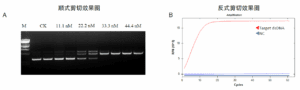
A: 1% TAE gel electrophoresis was used to analyze the cis-shearing effect of this product on plasmid Supercoiled pBR322 DNA.
M is λ-Hind Ⅲ digest, CK is the control group without AsCas12a enzyme, and 11.1 nM~44.4 nM is the experimental group containing different concentrations of AsCas12a enzyme.
The results showed that the CK group did not contain AsCas12a enzyme and was unable to form AsCas12a-crRNA complex, and therefore would not cleave the target pBR322, whereas in the experimental group, in the crRNA
guided by the fact that the proportion of AsCas12a-crRNA complexes in the system increased with increasing enzyme concentration, and the linearization formed by cleavage of the target pBR322
The fragment content increased. At an enzyme concentration of 33.3 nM, the target pBR322 is completely linearized and presents a single fragment.
B: Real-time fluorescence quantitative PCR instrumentation to detect the trans-shearing effect of AsCas12a enzyme.
NC is the control group without target pBR322 DNA, and Target dsDNA is the experimental group with target pBR322 DNA. cas12a enzyme is associated with crRNA, target pBR322 DNA, and target pBR322 DNA.
322 After formation of the ternary complex, ssDNA with fluorescent motifs (-FAM) and quenching motifs (-BHQ1) in the system is fragmented and fluoresces under crRNA guidance.
The results show that the NC group did not add the target pBR322 DNA, the trans activity could not be activated, and the ssDNA probe in the system could not be cleaved and did not produce fluorescence; the experimental group added the target pBR322 DNA, and the experimental group added the target pBR322 DNA.
After targeting pBR322 DNA, the trans activity is activated, and the amount of fluorescence generated by the cleavage of the ssDNA probe in the system increases with increasing reaction time, and when the probe is completely
After full cleavage, the resulting fluorescence signal reaches a plateau.