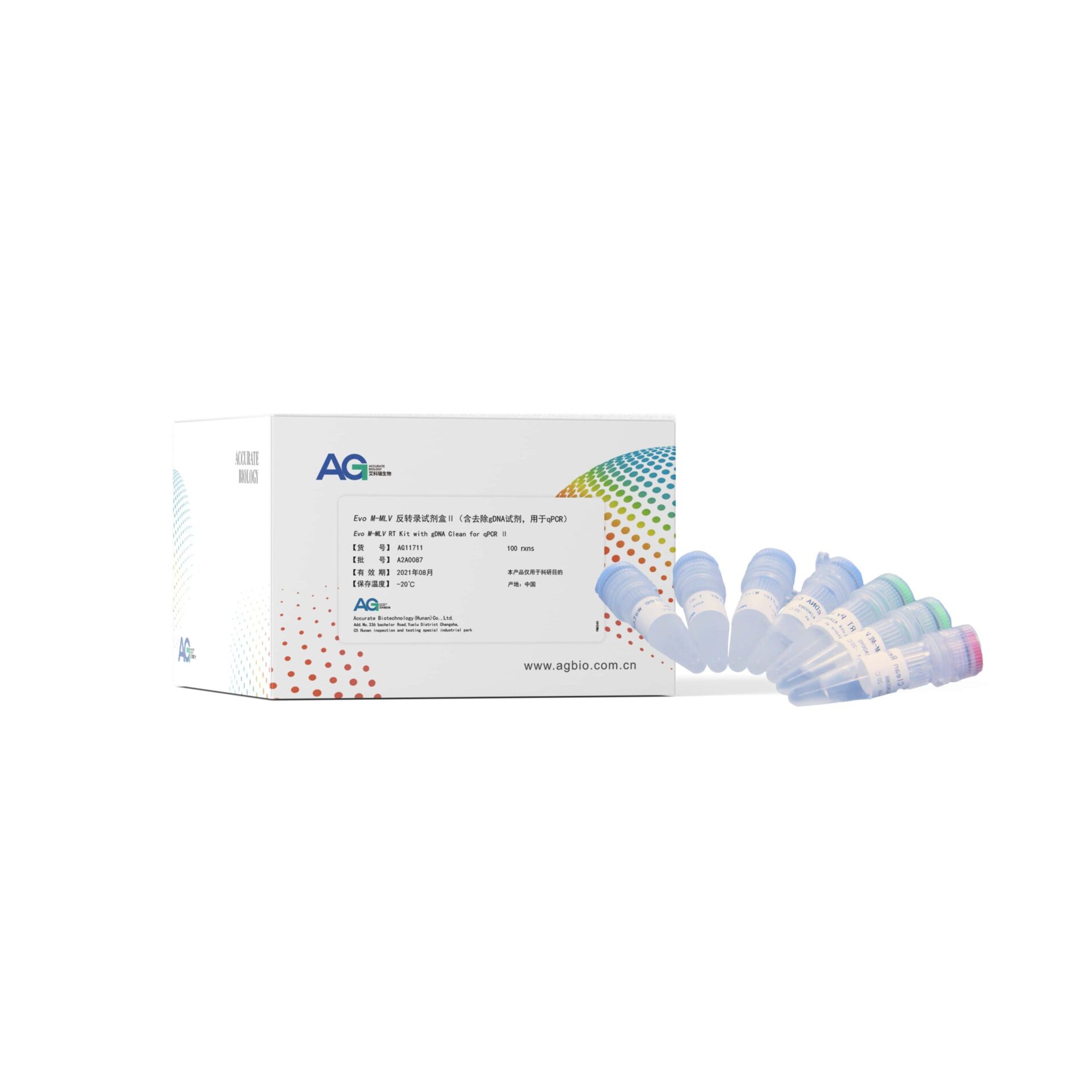
Evo M-MLV Reverse Transcription Kit II (contains gDNA removal reagent for qPCR)

Product Code: AG11711

- +

¥1,400

Product Description

This product utilizes M-MLV Reverse transcription kits for reverse transcription polymerase. The cDNA product can be used directly in qPCR assays. This product is available in Evo M-MLV Based on the RT Kit with gDNA Clean for qPCR (Code. AG11705), the primers are mixed to make RT Primer Mix, which is convenient to use and can reduce the experimental error. The kit uses gDNA Clean Reagent, which has strong DNA decomposition activity, to remove genomic DNA at 42 ℃ for 2 min, which effectively reduces the impact of genomic DNA on the quantitative analysis of cDNA. The cDNA synthesized by this product is suitable for chimeric and probe-based qPCR analysis.

Product Advantages

The gDNA Clean Reagent is a genomic DNA removal reagent that removes genomic DNA from RNA templates quickly.
② The RT Primer Mix in the kit is a mixture of Oligo dT (18T) Primer and Random 6 mers Primer, and the primer dosage has been optimized to facilitate the operation and reduce the experimental error.
③ The cDNA obtained by inversion of this product can be used for both SYBR and probe qPCR analysis.

Product Composition
individual parts making up a compound norm
gDNA Clean Reagent 100 μl
5X gDNA Clean Buffer 200 μl
Evo M-MLV RTase Enzyme Mix *1 100 μl
5X RTase Reaction Buffer Mix I*2 400 μl
RT Primer Mix*3 100 μl
RNase free water 1 ml x 2 pc

*1: contains Evo M-MLV  RTase and RNase Inhibitor.
*2: Contains dNTP.
*3: Contains Oligo dT (18T) Primer with Random 6 mers Primer.

Preservation and transportation
Storage temperature: -20℃
Transportation temperature: dry ice or -20℃ ice bag transportation
Example 1

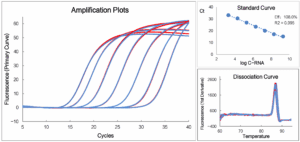
Add 200 ng of mouse genomic DNA into mouse liver total RNA (2 μg, 200 ng, 20 ng, 2 ng, 200 pg, 20 pg, 2 pg, 0 pg, respectively), and then use this kit to remove genomic DNA, and after removing the genomic DNA, carry out the reverse transcription experiment, and take 2 μl of this cDNA as a template, and take 2 μl of the original cDNA. After removing the genomic DNA, reverse transcription was performed using this cDNA as a template. Pro Taq HS Premix qPCR kit (Code. AG11701) for qPCR amplification to detect mouse GAPDH Genes.

The results are shown above:
① Working curve R2= 0.995 and the amplification efficiency was 108.01 TP3T.
In the sample without RNA but with gDNA, the Ct value was not detected within 35 cycles.
③ This product has a high reversal efficiency and can be accurately quantified over a wide template range. The cDNA amplification curves obtained by reverse transcription of 2 μg ~ 2 pg Total RNA show good linearity.
④ The melting curve has a single peak type and good amplification specificity.

Example 2

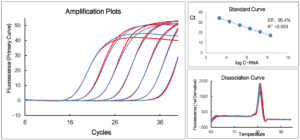
Total RNA of 293T cells with different gradients was used as template (2 μg~20 pg), reverse transcription was performed with this kit, and 2 μl of the cDNA stock solution was taken, and the cDNA was analyzed by SYBR Green. Pro Taq HS Premix qPCR kit (Code. AG11701) for qPCR detection Human H32F Genes.

The results are shown above:
① Working curve R2= 0.999 and the amplification efficiency was 96.4 %.
② No RNA was added to the human genome samples, and the Ct value was not detected within 35 cycles.
③ This product has a high reversal efficiency and can be accurately quantified over a wide template range. The cDNA amplification curves obtained by reverse transcription of 2 μg ~ 2 pg Total RNA show good linearity.
④ The melting curve has a single peak type and good amplification specificity.

Example 3

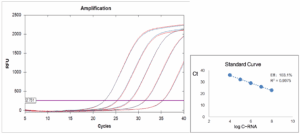
Total RNA from 293T cells was reverse transcribed using this product, and the starting amount of Total RNA was 1 μg~100 pg. 2 μl of cDNA stock solution was taken from the reverse transcription product as template, and Human RNA was detected by qPCR using the probe method.β-actin Gene (qPCR use) Pro Taq (HS Premix Probe qPCR Kit, Code. AG11704 performed).

The results are shown above:
①Working curve R2= 0.997 with an amplification efficiency of 103.11 TP3T;
②This product has a high reversal efficiency and can be accurately quantified over a wide template range. The cDNA amplification curves obtained by reverse transcription of 1 μg ~ 100 pg Total RNA show good linearity.